Search
Enter a vertical, competitor, or keyword, or provide a manual ad media URL for the analysis run.
I built AngleScope for affiliate and performance marketing teams that need to find winning ad angles, understand why they work, and turn those patterns into new testable creative concepts without pretending to have private ad-account data.
The Render demo is hosted on a free instance, so first load can take a moment if the service is asleep.
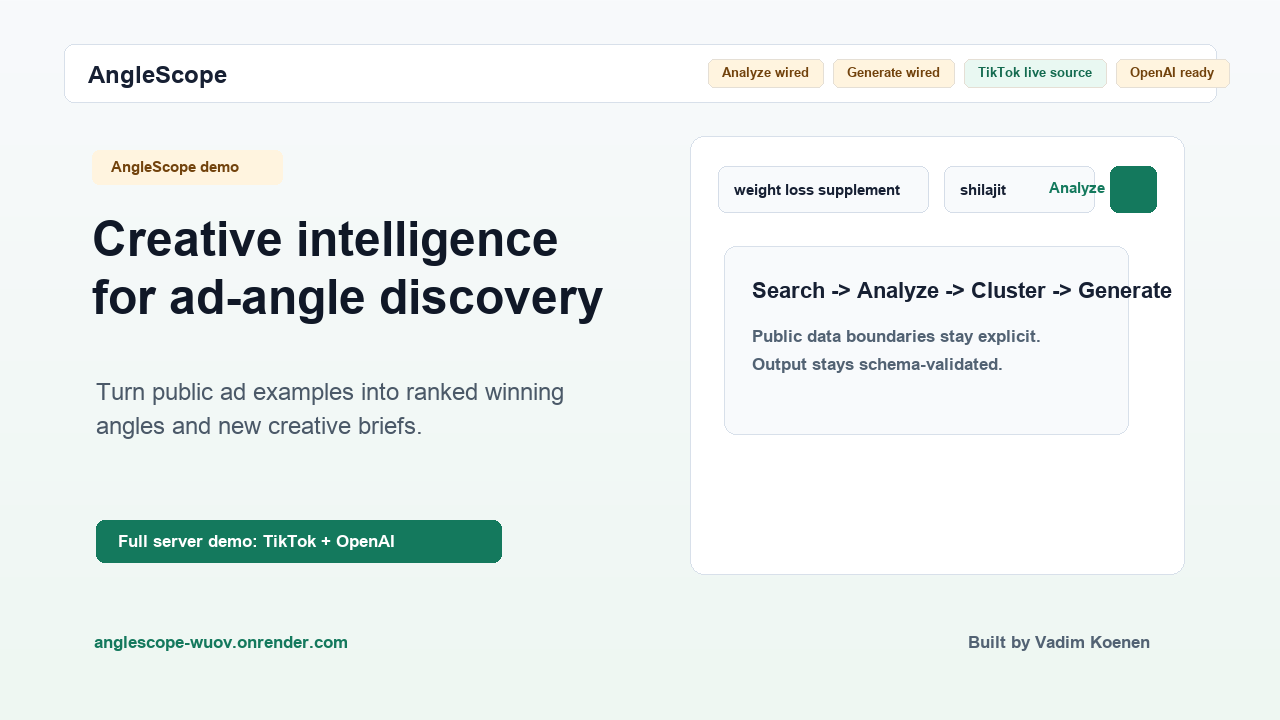
AngleScope is deliberately not a fake spend dashboard. As an outside builder, I did not have private Meta, Google, TikTok, Taboola, landing-page, or lead-quality data. So I focused on the part of the buyer workflow that can work honestly today: public ad examples, user-supplied creative, structured AI deconstruction, and evidence-backed concept generation.
Creative angle discovery is often one of the highest-leverage parts of affiliate media buying. Buyers scroll ad libraries, save examples, look for ads that appear to keep running, infer which hooks and proof patterns are working, and translate those patterns into the next batch of tests.
That work is valuable, but it is slow, uneven, and easy to lose in screenshots and scattered notes.
AngleScope turns that research loop into software: collect examples, classify what is happening, cluster recurring angles, rank them with evidence, and generate offer-specific concepts that a buyer can actually test.
The goal is not to replace the operator. The goal is to give the operator a sharper starting point.
Enter a vertical, competitor, or keyword, or provide a manual ad media URL for the analysis run.
Load validated seed examples and best-effort public examples from TikTok Creative Center when the server app is running.
Classify hooks, emotional angles, formats, offer mechanics, CTAs, claims, and compliance risk.
Group recurring winning angles and rank them with evidence from source ads and strength scoring.
Turn selected angles and offer details into new creative concepts, copy, briefs, and image direction.
Make the output usable outside the demo with JSON and CSV export paths.
The next version would connect internal performance data so AngleScope can learn from actual winners and losers, not only public examples. That means joining ad creative attributes to ROAS, CPL, lead quality, approval risk, and funnel drop-off.
From there, it becomes a creative operating system: discover public winners, deconstruct internal winners, generate compliant variants, match each angle to landing-page or advertorial treatments, and recommend the next tests based on observed performance.
AngleScope is useful as featured work because it shows the same operating pattern behind strong GTM systems: understand the real workflow, define the data boundaries, build a repeatable system, and keep the output practical enough for an operator to use.